Are Matcha Bars a Thing?
Are matcha bars actually a thing? Exploring the rise of dedicated matcha venues, from traditional tea service to modern matcha cocktails and desserts.
If you've been paying attention to the drinks scene over the past few years, you've probably noticed matcha creeping into more and more places. What started as an occasional offering at progressive coffee shops has evolved into something more substantial. So when someone asks whether matcha bars are actually a thing, the short answer is yes – but it's more nuanced than that.
The Matcha Movement Beyond Coffee Shops
Matcha bars exist, but they're not everywhere yet. Cities like London, New York, and Los Angeles have seen dedicated matcha-focused venues pop up, offering everything from traditional whisked matcha to elaborate matcha-based cocktails and desserts. These aren't just coffee shops that happen to serve matcha lattes – they're spaces built entirely around the versatility of this powdered green tea.
The concept makes sense when you consider matcha's unique properties. Unlike regular tea, which you steep and discard, matcha involves consuming the entire leaf in powdered form. This means higher caffeine content than most teas, a sustained energy release without the crash, and a distinctive umami-rich flavor profile that works in both traditional and experimental applications.
What Makes a Matcha Bar Different
A proper matcha bar approaches the ingredient with the same seriousness that specialty coffee shops bring to their beans. They source ceremonial-grade matcha from specific regions in Japan, understand the importance of water temperature and whisking technique, and can explain the difference between different cultivars and processing methods.
The menu typically goes far beyond the matcha latte that most coffee shops offer. You'll find traditional whisked matcha served in bowls, matcha-based cocktails, elaborate layered drinks with different grades of matcha, and often an entire food menu built around complementary flavors. Some focus on the meditative, ceremonial aspect of matcha preparation, while others lean into its potential as a cocktail ingredient or dessert base.
The UK Matcha Scene
In the UK, dedicated matcha bars are still relatively uncommon outside of London, but matcha as a category has definitely gained traction. Most specialty coffee shops now offer at least one matcha-based drink, and the quality has improved significantly as suppliers have started importing better grades of matcha powder.
The challenge for matcha bars in the UK market is education and expectation management. Many people's first experience with matcha comes from the sweetened, often artificial-tasting versions found in chain stores or bubble tea shops. Proper matcha – especially the higher grades – has a complex, sometimes challenging flavor profile that can be quite different from what people expect.
Why Matcha Works as a Standalone Concept
Matcha bars succeed where they exist because matcha offers something coffee doesn't: versatility across temperature, sweetness levels, and preparation methods. You can serve it hot or cold, sweet or bitter, whisked traditionally or blended into elaborate creations. It works as a morning ritual, an afternoon pick-me-up, or an evening wind-down drink depending on how it's prepared.
There's also the wellness angle, though this can be overstated. Matcha does contain L-theanine, which can provide a calmer energy boost compared to coffee, and it's rich in antioxidants. But matcha bars that succeed tend to focus on flavor and experience rather than health claims.
The Reality Check
While matcha bars exist and can work well in the right markets, they face some practical challenges. Good matcha is expensive – significantly more costly per serving than coffee. The preparation requires more skill and time than pulling an espresso shot. And the target market, while growing, is still smaller than the coffee-drinking population.
Most successful matcha-focused venues either operate in areas with high foot traffic and adventurous customers, or they've diversified their offerings to include coffee, other teas, or substantial food menus. Pure matcha bars are rare outside of major metropolitan areas.
Could Pop-Up Matcha Work?
This is where the mobile model becomes interesting. Instead of committing to a permanent matcha bar in an uncertain market, a pop-up approach could test demand in different areas, appear at events where the demographic skews toward matcha-curious customers, or complement existing coffee service with a premium matcha offering.
The prep requirements for quality matcha service aren't as equipment-intensive as espresso, but they do require knowledge, proper whisks, and crucially, access to good matcha powder. A mobile matcha service could work particularly well at wellness events, corporate wellness days, or locations where the usual coffee crowd might appreciate an alternative.
The Verdict
Matcha bars are definitely a thing, but they're still a niche within the broader drinks landscape. They work best in markets where there's already an appreciation for specialty beverages and customers willing to pay premium prices for quality ingredients and preparation.
The growth trajectory suggests we'll see more matcha-focused venues, but they'll likely remain concentrated in urban areas with the right demographic mix. For most places, matcha will continue to be an addition to existing coffee menus rather than the foundation of an entire venue.
Whether you're considering visiting one or thinking about the business potential, matcha bars represent an interesting evolution in how we think about tea service – taking an ancient preparation method and building a modern beverage experience around it.
What’s a Pop-Up Coffee Bar?
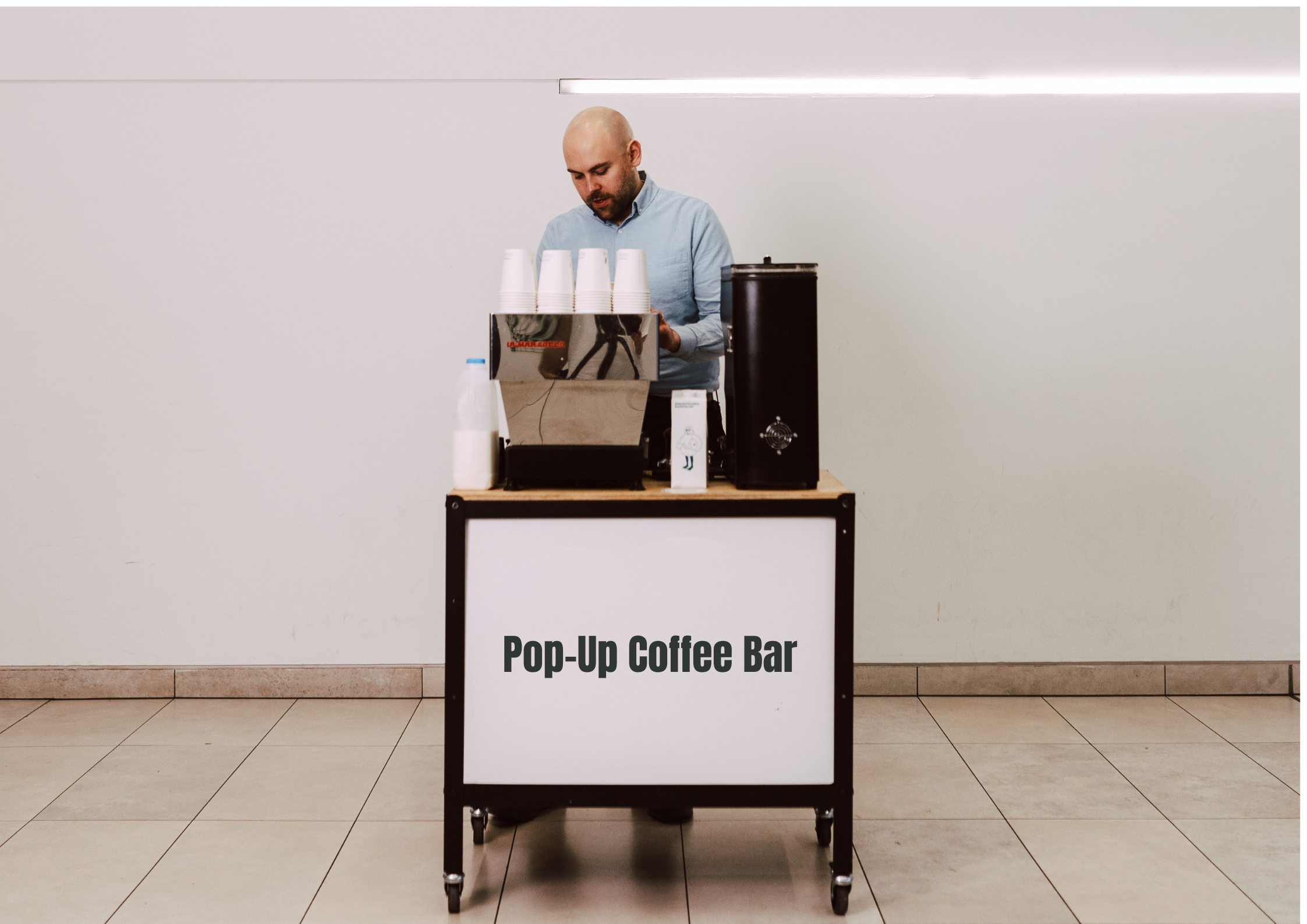
Pop-up coffee bars bring specialty coffee directly to your workplace or event. Professional baristas, commercial equipment, café-quality results wherever you need them.
The third wave coffee movement has done its job. Most of us now know what a properly pulled espresso should taste like, we've got our go-to order (whether that's a flat white with oat milk or a long black), and we can spot a quality café from the street. The problem? All that knowledge doesn't help when you're stuck in an office with instant coffee or at an outdoor event with nothing but filter coffee from a thermos.
This is where pop-up coffee bars come in – taking everything you've learned to appreciate about specialty coffee and making it available wherever you actually need it.
The Pop-Up Model: Retail Meets Reality
Pop-up retail has been around for decades, built on a simple premise: instead of waiting for customers to find you, go where they already are. Fashion brands use pop-ups to test new markets, artists create temporary galleries in unexpected spaces, and food vendors appear at events where people are already gathering and hungry.
The model works because it's responsive rather than static. It adapts to demand, creates exclusivity through scarcity, and builds genuine connections with communities by showing up when and where it matters most.
Coffee That Comes to You
We've applied this same logic to specialty coffee. Instead of another café on a street corner, we bring professional-grade equipment and properly trained baristas directly to your workplace, team day, or event.
The beauty lies in the flexibility. Your office might have a great local café five minutes away, but when you're deep in a project or back-to-back in meetings, five minutes becomes impossible. Or you're organising a team day in a location that's perfect for everything except decent coffee. These are the gaps we fill.
Think of it as coffee infrastructure that appears where and when it's needed most. The same quality you'd expect from your favorite third wave café, but without the commute or the queue.
Beyond the Basics: Why Quality Still Matters
By now, most coffee drinkers understand the fundamentals. You know that darker doesn't mean stronger, that the best cafés roast their beans within weeks rather than months, and that a barista who can create latte art probably knows how to steam milk properly.
What you might not have considered is how much location affects your coffee experience. Even when you know what good coffee tastes like, you're often forced to compromise based on convenience, opening hours, or simple geography.
Specialty coffee has become more accessible, but it's still geographically constrained. The best roasters tend to cluster in city centers and trendy neighborhoods. Corporate catering typically prioritizes volume over quality. Event organizers focus on logistics rather than taste.
We're interested in solving that distribution problem – making sure that your understanding and appreciation of good coffee isn't limited by where you happen to be at 9 AM on a Tuesday.
Our Approach: Professional Standards, Flexible Location
We use the same commercial-grade espresso machines you'll find in established specialty coffee shops. Our beans come from roasters who source ethically and roast to highlight origin characteristics rather than mask them. Our baristas understand extraction ratios, milk temperature, and the difference between a cortado and a gibraltar.
The difference is mobility. Instead of investing in property and fitting out a permanent space, we've built our setup to travel. This means we can appear at your office for a morning meeting, set up at a team away-day, or provide coffee service for an outdoor event – all while maintaining the same standards you'd expect from your regular coffee spot.
The Practical Reality
Most corporate coffee solutions prioritize convenience and cost over quality. Most event catering treats coffee as an afterthought. Most outdoor activities involve compromising on your morning ritual.
We're not trying to replace your local café or change your daily routine. We're there for the times when your usual coffee source isn't practical or available. When you're hosting clients and want to serve something better than whatever comes out of the office machine. When you're planning a team day and realize the venue's coffee situation is an afterthought. When you want to add a professional coffee service to an event without the complexity of a full catering setup.
It's specialty coffee as infrastructure rather than destination – showing up where it's needed, when it's needed, with the quality you've learned to expect.
Why This Matters Now
The coffee landscape has changed dramatically over the past decade. Specialty coffee knowledge has become mainstream, home brewing equipment has improved, and people's expectations have risen accordingly. What hasn't changed is the geographic and temporal limitations of where good coffee is available.
Remote work has made this more apparent. People who used to have access to quality coffee near their office now find themselves working from locations where the nearest decent café might be miles away. Team meetings happen in co-working spaces, off-site venues, and outdoor locations that weren't chosen with coffee in mind.
Pop-up coffee service acknowledges this new reality. It takes the quality standards that the specialty coffee movement has established and makes them available in the places where people actually work, meet, and gather.
Need professional coffee service that matches your standards? Our pop-up coffee bar brings café-quality espresso to your location, equipped with commercial-grade equipment and baristas who understand specialty coffee